

3 Pro Tips For Dealing with Boot in a 1031 Exchange

Boot in a 1031 exchange

Receiving any taxable boot during the 1031 exchange process can completely derail your like-kind exchange. In this article, we are going to walk through three pro tips for dealing with boot in a 1031 exchange of real estate.

Watch for Prorated Taxes, Rents & Security Deposits

Keep an eye out for prorated taxes, rents, or security deposits charged back at closing. These can created unintended boot. Have your tax advisor review your settlement statement before you close on your property.

Do The “Boot Test”

Use the “Boot Test” – if your replacement property value and debt assumed is greater than or equal to your relinquished property value and debt paid off, then you are probably safe.

Keep Your Hands Off the Proceeds

Never touch the proceeds yourself. The moment you (or your agent) have access to the funds, it is considered constructive receipt and your 1031 exchange will fail.

Like-Kind Exchange Company in Minnesota

Don’t let boot catch you off guard in a 1031 exchange. Even small details can turn your tax-deferred exchange into a taxable event. Partner with a qualified intermediary who keeps every dollar segregated and compliant.

If you’ve been searching for a like-kind exchange company in Minnesota, you’re in the right place! CPEC1031, LLC is a Minneapolis-based like-kind exchange company with more than two decades of experience in the 1031 exchange industry. We have a skilled team of qualified intermediaries standing by to walk you through the specifics of your next 1031 exchange. Whether you’re doing a forward exchange, reverse exchange, construction exchange, or something more complex – we’ve got the knowledge and expertise to make sure you are able to defer 100% of your capital gains taxes.

  • Start Your 1031 Exchange: If you have questions about 1031 exchanges, feel free to call me at 612-643-1031.

Defer the tax. Maximize your gain.

© 2025 Copyright Jeffrey R. Peterson All Rights Reserved
 

Video – 1031 Exchange Boot & Buying Down in Value

A Lesson About Basis & Why You Need to Involve Your Tax Advisor in Your 1031 Exchange

Ouch! You thought you were going to defer your gains in a partial 1031 exchange. Knowing that you were buying down in value, you hoped that you would get some benefit from the 1031 exchange. But you’re disappointed now because you bought a replacement property that was too far down in value. The reason that you’re not getting any tax deferral is that you have a transferred basis in a 1031 exchange. Your old basis transfers to the new property and you only start enjoying tax deferral for every dollar of value you buy over and above your transferred basis.

The starting point for this analysis is to talk to your accountant or tax advisor and ask what your current adjusted basis is and how low you can buy while still enjoying some measure of tax deferral.

Another way to fix this problem is to identify and purchase multiple replacement properties and cobble together enough value to get the desired tax deferral.

You could also do a build-to-suit exchange in which you erect improvements upon the replacement property during your 180 day exchange period to increase the value of the replacement property and enhance the amount of tax deferral that you enjoy.

CPEC1031, LLC – Your 1031 Exchange Intermediaries

Find a qualified intermediary for your next like-kind exchange by contacting CPEC1031, LLC. We have been facilitating like-kind exchanges under section 1031 of the Internal Revenue Code for decades. Our intermediaries have the knowledge and skills necessary to guide you through each and every stage of your 1031 exchange. Whether you’re conducting a forward exchange, a reverse exchange, or a construction exchange, we can help. Contact us today at our Twin Cities office in downtown Minneapolis to start the process!

  • Start Your 1031 Exchange: If you have questions about 1031 exchanges, feel free to call me at 612-643-1031.

Defer the tax. Maximize your gain.

© 2025 Copyright Jeffrey R. Peterson All Rights Reserved

Video – Can I Sign a Purchase Agreement in a 1031 Exchange?

A common question that many people ask when they’re doing a 1031 exchange is:

“Can I sign a purchase agreement for the purchase of the replacement property even before closing on the sale of the relinquished property?”

The answer is yes, but it’s a very common misconception. In fact, not only can you sign a purchase agreement for your replacement property, you can also do a reverse exchange and have your intermediary acquire the replacement property as your surrogate.

Contact a Qualified Intermediary at CPEC1031, LLC

Contact a qualified intermediary at CPEC1031, LLC for help with your next like-kind exchange under section 1031 of the Internal Revenue Code. We have more than two decades of experience facilitating exchanges of all types - forward, reverse, construction, and more. We are well suited to handling all aspects of the like-kind exchange process and can make sure you do everything necessary to defer 100% of your capital gains tax burden when selling qualifying real estate. Reach out to our team today to set up a time to chat about your next exchange!

  • Start Your 1031 Exchange: If you have questions about 1031 exchanges, feel free to call me at 612-643-1031.

Defer the tax. Maximize your gain.

© 2025 Copyright Jeffrey R. Peterson All Rights Reserved

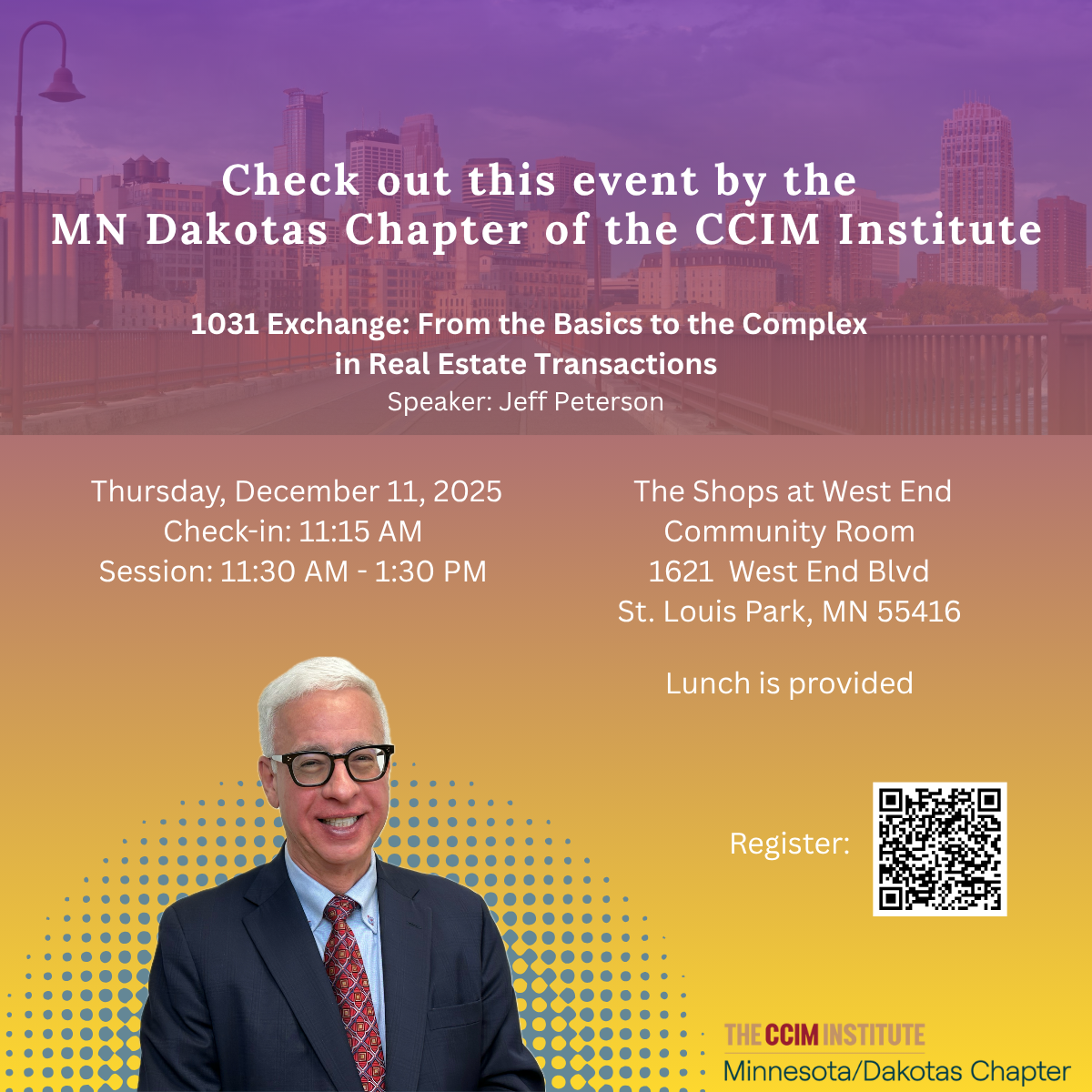
Register Now - 1031 Exchange: From the Basics to the Complex in Real Estate Transactions

Presented by Jeffrey Peterson, President of CPEC1031

This program provides professionals with an understanding of I.R.C. Section 1031 Exchange rules, including foundational principles, real-world applications, and complex structuring scenarios. Topics include tax deferral theory, identification rules, related-party issues, drop & swap structures, and reverse exchanges.

At the end of the session, attendees will be able to:

  • Explain the key principles and historical context of I.R.C. Section 1031 exchanges

  • Identify the requirements for valid like-kind property and proper transaction structuring

  • Recognize timing rules, disqualifying situations, and common pitfalls

  • Understand complex strategies including reverse exchanges and drop & swap scenarios

2 hours of MN Real Estate CE applied for. 

Event Details

  • Date: Thursday, December 11, 2025

  • Time: 11:30 AM – 1:30 PM

  • Location: The Shops at West End Community Room. 1621 West End Blvd, St. Louis Park, MN 55416

This is a lunch and learn event. Lunch will be provided. Please check in 15 minutes prior to the event to grab your lunch and be ready to learn. 

Register Now

The 45-Day Countdown – Identification Rules in a 1031 Exchange

You sold your property in a 1031 exchange and now the clock is ticking! You have only 45 days to identify your replacement property. That countdown starts the day after your relinquished property closes (the closing date is day 0). There are no extensions or exceptions (except in the case of some federally declared disasters). It’s important to remember that weekends and holidays count too.

3 Identification Rules in a 1031 Exchange

  1. 3-Property Rule. You may identify up to three properties and there is no value limit. You can purchase one, two, or all three properties within 180 days.

  2. 200% Rule. Identify any number of properties as long as their total value does not exceed 200% of what you sold. For example, if you sold $1 million, you can identify up to $2 million in total value.

  3. 95% Rule. If you go over both the 3-property and the 200% limits, you must acquire at least 95% of the total value identified. This rule is rarely used, but it can save a complex 1031 exchange.

How to Identify Your Property

Now that you know the identification rules, how do you go about actually identifying your property in a 1031 exchange?

  • In writing on the Replacement Property Identification Form, signed by you, and delivered to your Qualified Intermediary.

  • After Day 45, you cannot add or subtract properties.

  • If a deal falls through, or if a property is not on your list, it is too late.

  • After the sale date, you must complete the purchases within 180 days or before your tax return is due, whichever comes first.

Pro Tips for a Successful 1031 Exchange

  • Plan ahead and consult with your tax advisor, CPA, and your Qualified Intermediary.

  • Confirm your written notice (Replacement Property Identification Form) is received on time to your Qualified Intermediary.

  • Consider identifying “in the alternative” by listing Property A or B, not both.

  • Lock up a replacement property early by getting it under contract for purchase, or purchasing the property in a reverse exchange.

CPEC1031, LLC – Your Go-To Resource for 1031 Exchanges

At CPEC1031, LLC we are your go-to resource for all things related to 1031 exchanges. With more than two decades of experience under our belts, we have the knowledge needed to guide you through the complicated web of your 1031 exchange and ensure you are able to defer all of your capital gains taxes when it comes time to close on your replacement property. Give us a call today to learn more about the many benefits of section 1031 of the Internal Revenue Code and see if your property qualifies for like-kind exchange tax deferral.

  • Start Your 1031 Exchange: If you have questions about 1031 exchanges, feel free to call me at 612-643-1031.

Defer the tax. Maximize your gain.

© 2025 Copyright Jeffrey R. Peterson All Rights Reserved