
1031 Exchange

1031 Exchange Deadlines & Your Federal Tax Filing

In any 1031 exchange, you have 180 days from the start of your exchange to the finish of your exchange. However, this can get complicated by your federal income tax filing deadline.

If you start your 1031 exchange late in the year, you will find that your exchange period actually ends not at the 180th day after starting your exchange, but at the due date for the filing of your federal tax return. Let’s say you started your exchange on December 31st and you’re a partnership that files taxes on March 15th. In this situation you’re not going to get the full 180 day time period to complete your exchange unless you file an extension for your federal tax return. The same thing applies to individuals who file on April 15th. This is a real trap for the unwary.

I tell real estate agents to notify the other professionals that are in the client’s sphere (including the accountant) to let them know about the 1031 exchange so they can file for an extension if need be. The left hand and the right hand need to be working together and the advisors of the 1031 taxpayer need to be in lockstep throughout the process.

Minnesota 1031 Exchange Company

CPEC1031, LLC is a Minnesota-based 1031 exchange company that provides qualified intermediary services throughout the state and across the country. Our team of 1031 professionals has more than twenty years of experience working with taxpayers on their 1031 exchanges. We can help prepare your 1031 documents and answer all of your 1031-related questions before, during, and after the process. Contact us today to learn more about our 1031 exchange services and see how we can help you through the details of your next exchange.

  • Start Your 1031 Exchange: If you have questions about 1031 exchanges, feel free to call me at 612-643-1031.

Defer the tax. Maximize your gain.

© 2025 Copyright Jeffrey R. Peterson All Rights Reserved
Video – 1031 Exchange Rules of the Road

There are several basic rules of the road when it comes to 1031 exchanges.

  • It’s important to remember that partnership interests cannot be exchanged under section 1031 (generally speaking).

  • Many people want to cash out and take money off the table in a 1031 exchange. That triggers taxable boot and will invalidate the exchange.

  • And then there’s the issue of qualified use in a 1031 exchange. 

Let’s imagine that you exchange your south Minneapolis apartment building and buy an oceanfront condo in Sarasota, FL. You then plan to rent out that property for a number of years. Your initial intent is to hold that property for investment or business purposes (even though your long-term intent may not be clear). How long should you wait before converting that property to personal use? The safest answer is the longer the better.

We have had clients who have moved into their replacement properties and subsequently been audited so this is something you need to be aware of as a possibility.

There are IRS authorities (private letter rulings) that seem to indicate that two years is the standard minimum period of time that you should hold a replacement property before converting to personal use. To be extra careful, it’s a good idea to go longer than that two year minimum if possible.

Consider This Hypothetical:

You move into your Sarasota oceanfront property and then a better property becomes available a few years later. You want to sell that Sarasota property as your principal residence and purchase the new property. There’s another code section (121) that deals with the proceeds from the sale of one’s personal residence. Can you take the full 121 exclusion ($500K if you’re married, $250K if you’re single) on a property that you 1031 exchanged into? You used to be able to do this, but the rules have changed. Now you only get a fraction of the exclusion amount based on the ratio of time you rented the property out and the time you occupied it as your home. Let’s say you rented the property out for two years and then occupied it for another three years. In that situation, you would only get three-fifths of the 121 exclusion. The other thing to be aware of is that you can’t do a 1031 exchange and then do a principal residence exclusion until you wait five years. Once you 1031 into the property you have to wait five years before you take a principal residence exclusion on that particular property. Additionally, the principal residence exclusion does not exclude gain from the recapture of depreciation.

Rather than selling your principal residence and not getting the full exclusion and having to recoup the depreciation, you could elect to continue deferring your capital gains taxes in a 1031 until you die. When you die, your heirs will receive your property with a stepped up basis to the fair market value at the time.

1031 Exchange Company in Minneapolis, MN

CPEC1031, LLC works with real estate investors across the United States on 1031 exchange transactions that help defer capital gains taxes. With more than two decades in the 1031 exchange industry, our qualified intermediaries have the detailed knowledge necessary to ensure your exchange satisfies all the requirements of section 1031 of the Internal Revenue Code. Get the help you need on your next 1031 transaction by contacting our team. You can find us at our primary office located in downtown Minneapolis. Note that we work with clients who own property all over the country.

  • Start Your 1031 Exchange: If you have questions about 1031 exchanges, feel free to call me at 612-643-1031.

Defer the tax. Maximize your gain.

© 2025 Copyright Jeffrey R. Peterson All Rights Reserved

Video – What is Not Considered Like-Kind in a 1031 Exchange?

When you’re thinking about doing a 1031 exchange, there are two parts to the initial litmus test that you must satisfy:

  1. The exchange must be for like-kind property.

  2. The property involved must be held for a qualifying purpose.

Like-kind generally is very broad. Real estate is generally considered like-kind to other real estate. You can exchange the Empire State Building for a condominium in Naples, FL.

But what are some situations in which real estate may not be considered like-kind?

  • Leasehold estates of less than 30 years are not considered like-kind in the realm of 1031. This comes up when dealing with hangars at municipal airports, which are typically on 10 year leases.

  • Additionally, certain oil and gas rights are like-kind and some are not. You might need to hire a tax attorney to give you an opinion on whether your specific oil and gas interests qualify for 1031.

Work with a Qualified Intermediary on Your Next Like-Kind Exchange

Work with a qualified intermediary from CPEC1031, LLC on your next like-kind exchange of investment real property. Our team has been facilitating 1031 exchanges across the United States for decades. We can help you with your forward exchange, reverse exchange, or build-to-suit construction exchange. Reach out to us today at our Twin Cities office (located in downtown Minneapolis) to learn more about the tax saving power of section 1031 and see if your property qualifies. Our intermediaries are standing by to discuss your situation.

  • Start Your 1031 Exchange: If you have questions about 1031 exchanges, feel free to call me at 612-643-1031.

Defer the tax. Maximize your gain.

© 2025 Copyright Jeffrey R. Peterson All Rights Reserved

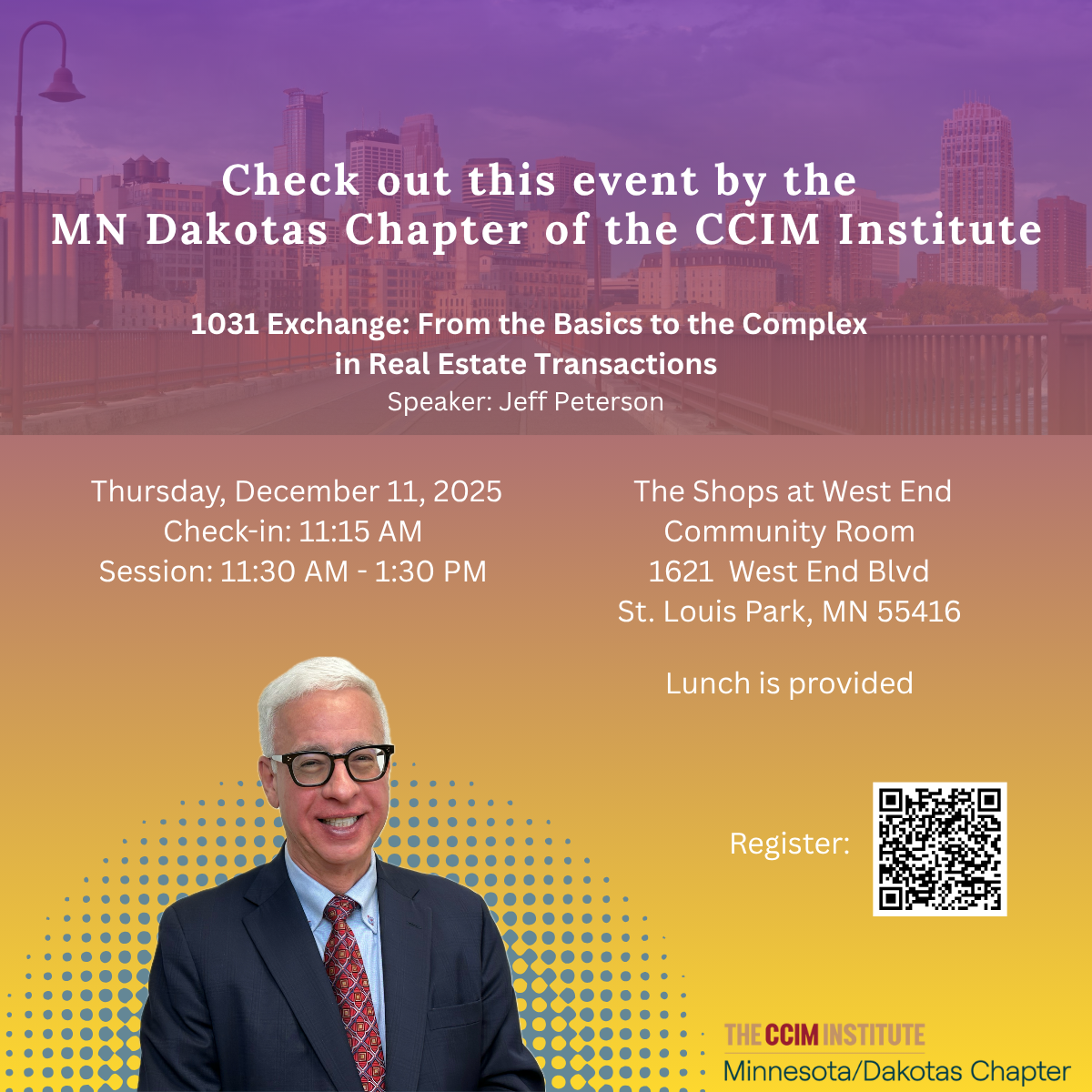
Register Now - 1031 Exchange: From the Basics to the Complex in Real Estate Transactions

Presented by Jeffrey Peterson, President of CPEC1031

This program provides professionals with an understanding of I.R.C. Section 1031 Exchange rules, including foundational principles, real-world applications, and complex structuring scenarios. Topics include tax deferral theory, identification rules, related-party issues, drop & swap structures, and reverse exchanges.

At the end of the session, attendees will be able to:

  • Explain the key principles and historical context of I.R.C. Section 1031 exchanges

  • Identify the requirements for valid like-kind property and proper transaction structuring

  • Recognize timing rules, disqualifying situations, and common pitfalls

  • Understand complex strategies including reverse exchanges and drop & swap scenarios

2 hours of MN Real Estate CE applied for. 

Event Details

  • Date: Thursday, December 11, 2025

  • Time: 11:30 AM – 1:30 PM

  • Location: The Shops at West End Community Room. 1621 West End Blvd, St. Louis Park, MN 55416

This is a lunch and learn event. Lunch will be provided. Please check in 15 minutes prior to the event to grab your lunch and be ready to learn. 

The 45-Day Countdown – Identification Rules in a 1031 Exchange

You sold your property in a 1031 exchange and now the clock is ticking! You have only 45 days to identify your replacement property. That countdown starts the day after your relinquished property closes (the closing date is day 0). There are no extensions or exceptions (except in the case of some federally declared disasters). It’s important to remember that weekends and holidays count too.

3 Identification Rules in a 1031 Exchange

  1. 3-Property Rule. You may identify up to three properties and there is no value limit. You can purchase one, two, or all three properties within 180 days.

  2. 200% Rule. Identify any number of properties as long as their total value does not exceed 200% of what you sold. For example, if you sold $1 million, you can identify up to $2 million in total value.

  3. 95% Rule. If you go over both the 3-property and the 200% limits, you must acquire at least 95% of the total value identified. This rule is rarely used, but it can save a complex 1031 exchange.

How to Identify Your Property

Now that you know the identification rules, how do you go about actually identifying your property in a 1031 exchange?

  • In writing on the Replacement Property Identification Form, signed by you, and delivered to your Qualified Intermediary.

  • After Day 45, you cannot add or subtract properties.

  • If a deal falls through, or if a property is not on your list, it is too late.

  • After the sale date, you must complete the purchases within 180 days or before your tax return is due, whichever comes first.

Pro Tips for a Successful 1031 Exchange

  • Plan ahead and consult with your tax advisor, CPA, and your Qualified Intermediary.

  • Confirm your written notice (Replacement Property Identification Form) is received on time to your Qualified Intermediary.

  • Consider identifying “in the alternative” by listing Property A or B, not both.

  • Lock up a replacement property early by getting it under contract for purchase, or purchasing the property in a reverse exchange.

CPEC1031, LLC – Your Go-To Resource for 1031 Exchanges

At CPEC1031, LLC we are your go-to resource for all things related to 1031 exchanges. With more than two decades of experience under our belts, we have the knowledge needed to guide you through the complicated web of your 1031 exchange and ensure you are able to defer all of your capital gains taxes when it comes time to close on your replacement property. Give us a call today to learn more about the many benefits of section 1031 of the Internal Revenue Code and see if your property qualifies for like-kind exchange tax deferral.

  • Start Your 1031 Exchange: If you have questions about 1031 exchanges, feel free to call me at 612-643-1031.

Defer the tax. Maximize your gain.

© 2025 Copyright Jeffrey R. Peterson All Rights Reserved